FIRST RUN
Survive The Swarm Beginner Guide: Classes, First Runs, and Gear
A beginner guide to Survive The Swarm classes, first runs, gold, gear, and evolutions, based on the official Roblox description and player-reported tips.
Overview
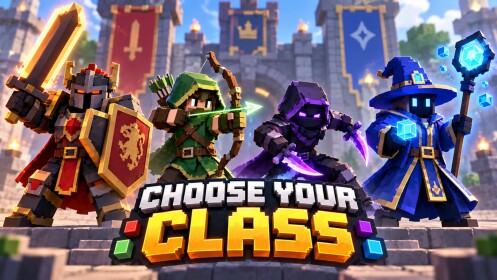
Survive The Swarm opens with a class choice and a campaign map, and the fastest way to enjoy your first runs is knowing what that class choice actually changes. The **official Roblox page** lists six classes — Warrior, Rogue, Mage, Ranger, Engineer, and Healer — and describes the game as an RPG where you fight hundreds of enemies at once with one goal: survive the swarm and defeat the final boss. The page publishes no stats, cooldowns, or unlock costs, so the beginner decision is less about finding a "best" class and more about picking a role you can play while you learn the maps.
Choosing a Class: What the Official Description Tells You
The official description gives each class a one-line identity:
Read those as role sketches rather than stat sheets. Each line points at a different way of handling a crowd: raw power, critical hits, spells, arrows from range, turrets and gadgets, or healing. That is all the official listing commits to, which is why class comparisons based on raw numbers aren't available from the source material collected here.
- Warrior — Charge into battle and crush enemies with raw power.
- Rogue — Strike from the shadows with lightning-fast critical hits.
- Mage — Unleash devastating spells that wipe out entire hordes.
- Ranger — Rain arrows from afar and never let enemies get close.
- Engineer — Deploy turrets and gadgets to control the battlefield.
- Healer — Keep your team alive and turn the tide of every fight.
What Actually Differs Between Classes
According to **one beginner gameplay video**, most weapons in the game are shared across all classes, so a large part of any loadout is available whichever class you pick. The same video reports that every class has its own dash and that some weapons are class-exclusive — they name the inferno fork as a Mage exclusive in their experience. Those are the creator's gameplay observations rather than official documentation, but they fit the official framing of six distinct classes.
In practice, that means your class mainly decides how you dash and which exclusive weapons you can use. The sources collected here don't describe how each class dash behaves, and the official page lists the six classes without saying whether they're all available on a new account.
Your First Run: Campaign, Loadout, and Armory
The beginner video walks through the pre-run flow: you enter portals, pick a campaign map, choose a loadout, and use the armory to manage your gear before starting. The armory is where that creator does all of their out-of-run preparation.
The official page frames the run itself as fighting large groups of enemies and beating a final boss. It also presents co-op as a way to team up with friends and clear every map together — that's the only multiplayer framing the official description gives.
For boss fights, one **solo walkthrough** offers two tactics from their own runs: stay behind the boss, because in their experience bosses attack from the front, and avoid jumping into zombies since you can still be hit by the hitbox mid-jump. Both are that player's observations, not official guidance, and they were described in the context of a specific build.
Gold, Gear, and Evolutions
Gold is the progression currency. The official description says you collect Gold to upgrade and unlock weapons and Gear, and that you synergize them to unlock their evolutions. That gives the core loop: run maps, collect Gold, spend it in the armory, and pair items that synergize to produce an evolution.
The solo walkthrough recommends building around weapons that show an evolution option and skipping weapons with no evolution path, and calls armor upgrades important even though they are expensive. The video does not establish that this rule is optimal for every class or every patch, so treat it as one player's route rather than a requirement. The beginner video takes a slightly different angle, recommending some early weapons on raw strength regardless of evolution status — a useful reminder that both approaches exist.
Beginner Build Advice Players Report
Everything below comes from player testing shown in the two videos, not from official documentation.
Because the developers describe weekly updates, these impressions can age quickly.
- **Permanent upgrades:** the solo walkthrough puts damage first in its permanent upgrade order, then adds weapon slots and passives. That is one player's sequence, not a required order.
- **Early weapons named by the beginner video:** butcher's cleaver (described as applying bleeding up to 20 stacks, but with short range), fire aura (a damaging aura around you that kills nearby enemies while you focus on the boss), heaven's aura, dark cloud, and lightning staff, plus the inferno fork, which they believe is Mage-exclusive.
- **Evolutions that video rates highly:** bud shot, made from a gun plus the eagle eye or falcon eye, which they call the highest DPS they managed; dead eye, from shadow fang plus falcon eye, which marks the biggest enemy so it takes extra damage; doppelganger, which spawns a shadow twin that echoes what you do, though the creator notes they aren't sure how its statistics work; and ground breaker, from earth splitter plus boulder smasher, which they describe as a simple area-of-effect option.
- **Passives and pets:** both videos single out mending charm as the healing passive they use, and the solo walkthrough says to upgrade mending charm first when you get the chance. The beginner video also mentions using falcon eye or butcher's cleaver as a pet so runs still gain marking or bleeding effects on top of the main build.
Weekly Updates and What Isn't Documented
The official page describes its update cadence as weekly and adds "expect some bugs." That's the developer's own wording, and it doesn't guarantee a specific balance change every week — only that the game moves often.
Several things a beginner might want aren't established by the collected sources: current upgrade costs, weapon statistics, class unlock costs, and map rewards. Any specific numbers you see in a video are worth checking against the live game before you plan around them.
What is settled is the shape of the game: six classes, Gold spent on weapons and gear, evolutions from gear synergies, campaign maps with a boss at the end, and co-op for clearing maps with friends. Pick the class whose role line appeals to you, run an early campaign map, and put your first Gold into weapons and gear — the evolution system starts to matter once you have a few items to pair.
Keep the page honest
Use the version scope, source status, and verification date above when you quote this guide. If the game UI or source changes, update the claim before expanding the recommendation.
Sources to check